Carbon footprint estimationStart with an initial estimate
Use the calculator to explore the main sources of your company's greenhouse gas emissions and get an initial indication of your overall footprint.
This carbon footprint calculator is provided by OurOffset and embedded on the Mitigia website for informational purposes. The result is an indicative estimate based on the information entered into the calculator. It is just for information, definitely not a comprehensive or verified corporate carbon footprint and should not be used as a substitute for a detailed assessment.

Explore our solutions
360° service for carbon credit generation, registry, and trading with mitigia’s third-party verified Digital MRV.
They are already benefiting from carbon credits generated by their green investments

Our Clients
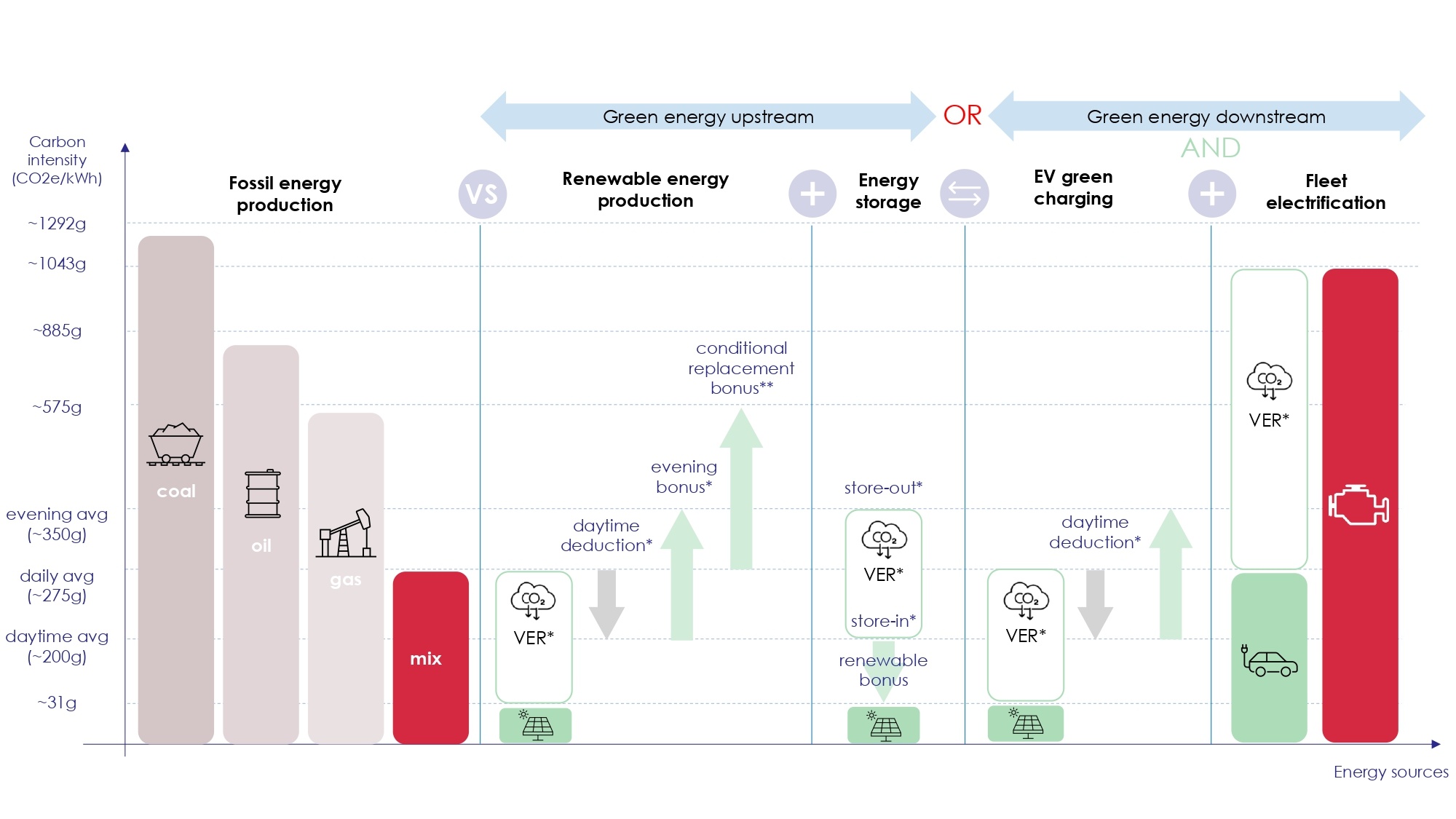
Four main obstacles hinder the spreading of electrification:
the renewable energy production challenge,
the energy storage challenge,
the charging challenge
and last, the EV challenge.
We target all of them with methodologies that built upon each-other.



.png?width=120&name=energy%20storage%20feh%C3%A9r%20ikon%20(1).png "energy storage fehér ikon (1)")
Our methodologies complement each other
...and cover the whole of the electrification ecosystem from renewable energy production to fleet electrification projects.
MONETIZE YOUR EMISSIONS REDUCTIONS
What is a carbon credit?
When you replace a CO2 intense technology with a more climate friendly or even a net zero one, you "spare" CO2 emissions. Thus, you, as an economic entity, realise a so called carbon gain. By comparing the two technologies, the volume of this carbon gain can be precisely measured, verified and reported, and exchanged into Verified Emission Reduction (VER) or Voluntary Carbon Unit (VCU).
What appears as a „spared" or "negative emission” on the green investors' side is sought after by net emitters whose emission volumes exceed the regulatory limits (and cannot avoid or reduce by themselves). These emitters either pay a penalty fee or buy carbon credits in exchange for their emissions. By choosing the second option they turn their ESG obligations into an opportunity to invest in green investments.
mitigia helps green investors originate and register carbon credits based on their electrification investments, and sell such carbon credits to large emitters.
Our know-how is compliant with the requirements of the VCM, thus the carbon credits originated through mitigia’s methodology qualify as high integrity carbon credits.
These credits represent a higher quality for the buyers, who are willing to pay a higher price for the reliability and transparency of the underlying projects the credits were originated from.
Our Partners
From estimation to actionA footprint you can act on
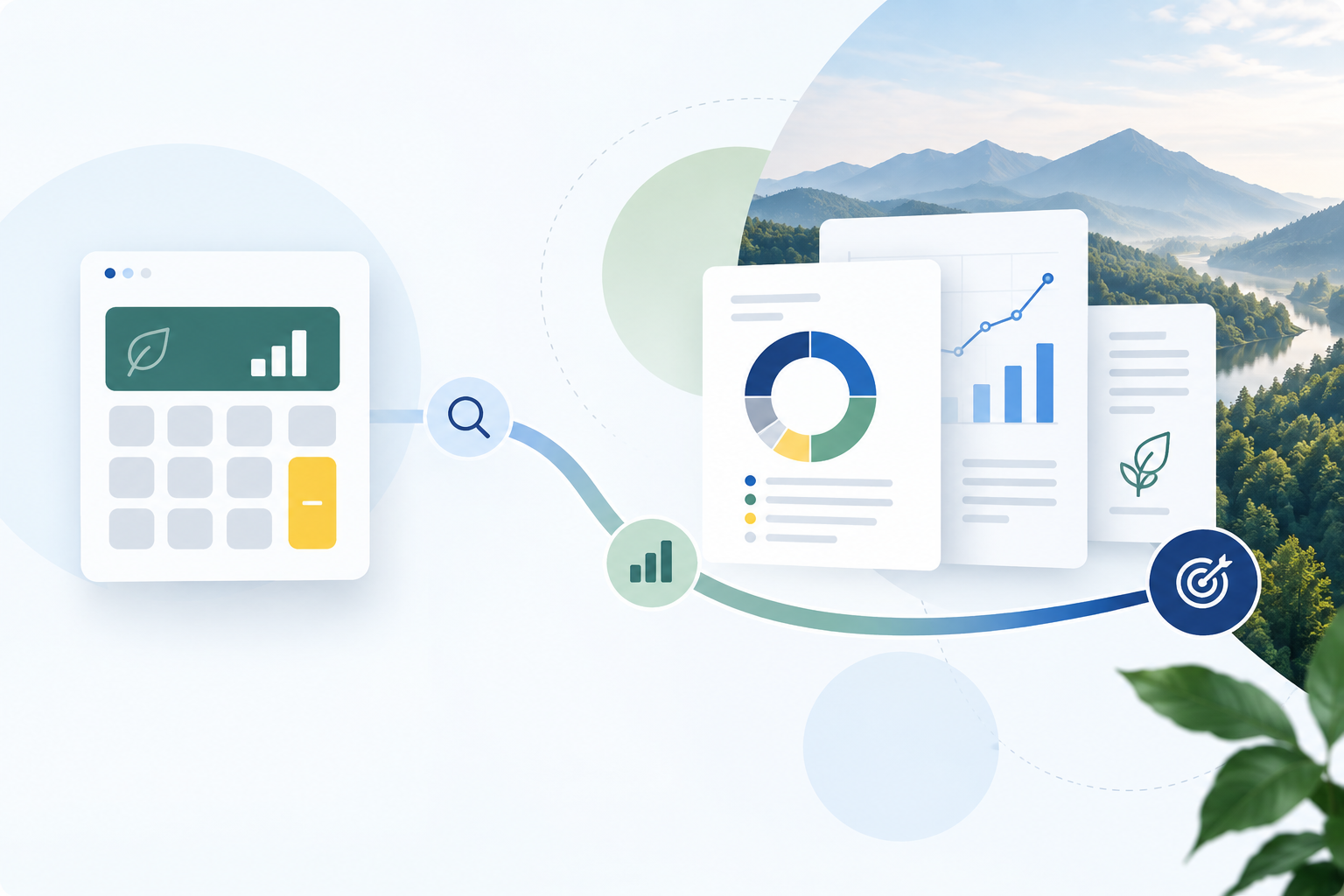
The quick estimate helps you understand the scale and main sources of your company's emissions. But when the result needs to support business decisions, sustainability reporting, reduction targets or carbon offsetting, a more detailed assessment is required.
Mitigia can help you turn that initial picture into a structured carbon footprint calculation as a basis for building a credible climate strategy. For accurate emissions accounting, reporting, determining the residual emissions you want to offset or identifying hotspots to launch value chain interventions along your supply chain, we help you develop a verifiable company-specific carbon footprint and value chain mapping based on your business activities, data and relevant emission sources.
Offset what remainsAddress the residual emissions you cannot eliminate yet
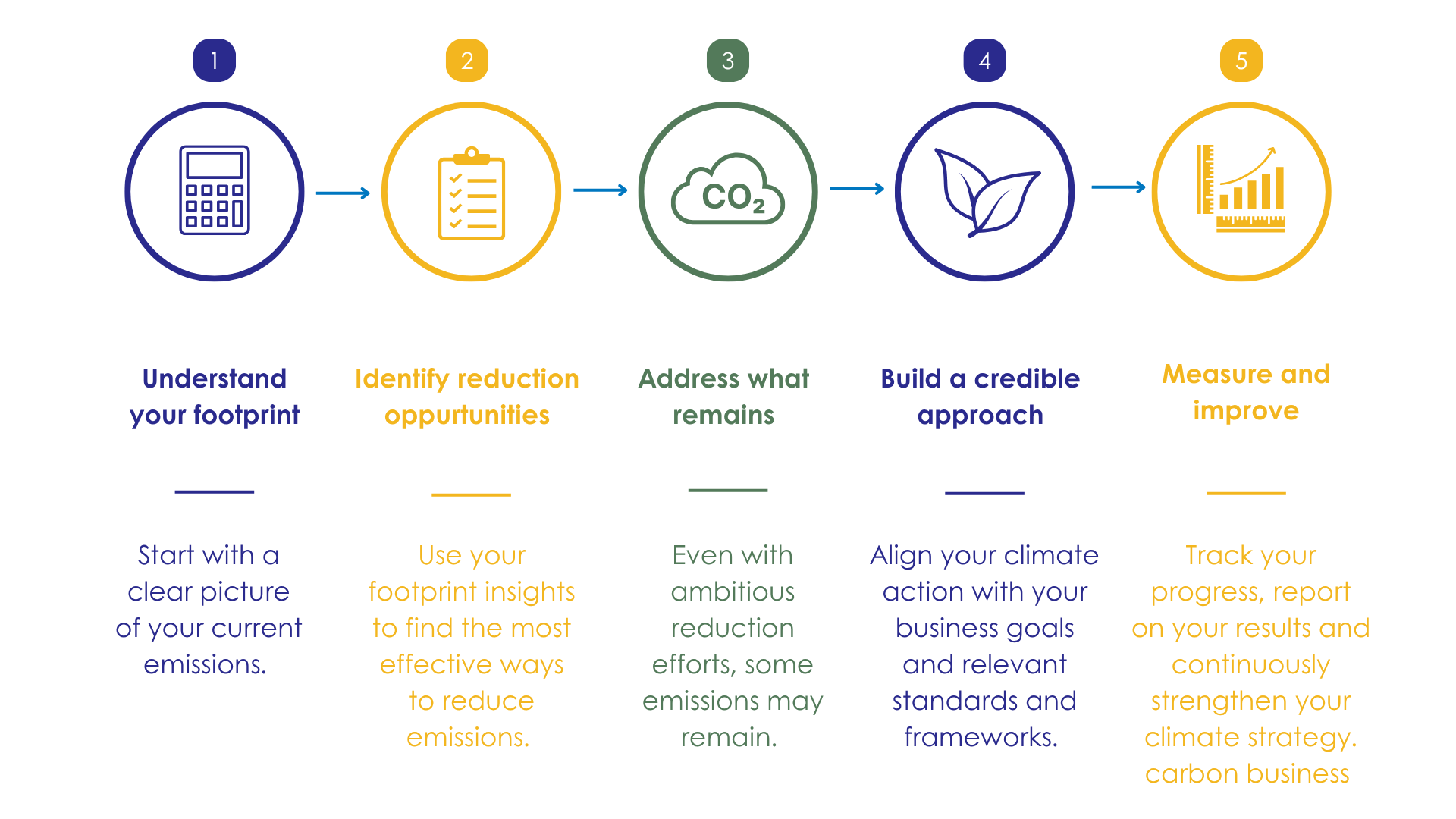
Even with ambitious reduction efforts, some emissions may remain for longer. Carbon credits based on recent projects within the EU and carefully developed by Mitigia can be a credible part of your climate strategy. We help you address the hard-to-abate residual emissions, while you continue to reduce your overall footprint. We provide you quality certificates form transparent European carbon projects with a good geographical and temporal fit to your residual emissions to offset.
Common questions
We give you straight answers
What is a carbon footprint?
A carbon footprint is an estimate of the greenhouse gas emissions associated with an organisation's activities. Depending on the scope of the assessment, it can include direct emissions from company operations (Scope 1), emissions from purchased energy (Scope 2) and indirect emissions across the value chain of the company (Scope 3).
How can I calculate my company's carbon footprint?
A carbon footprint can be estimated by collecting relevant activity data, such as energy use, fuel consumption, business travel, purchased goods and services, waste produced etc, and applying appropriate emission factors. A calculator can provide you an initial estimate, while a detailed carbon footprint assessment uses company-specific data, credible baselines and scrutinous verification.
What does a carbon footprint calculator measure?
A carbon footprint calculator estimates greenhouse gas emissions based on the activities and information entered by the user. It can help identify the main sources of total greenhouse gas emissions and provide an initial indication of the company's overall footprint.
How accurate is a carbon footprint calculator?
The accuracy of an estimate depends on the data provided, the emission factors used, the categories covered and the methodology behind the calculator. A calculator result should therefore be treated as an initial estimate rather than a comprehensive or verified corporate carbon footprint.
What is the difference between a carbon footprint estimate and a detailed assessment?
An initial estimate provides a quick indication of the scale and main sources of a company's emissions. A detailed assessment is based on company-specific activity data, defined boundaries, relevant emission sources and an appropriate calculation methodology, making it more suitable for reporting, target-setting and carbon management.
What should I do after calculating my company's carbon footprint?
The next step is to identify the main sources of emissions and assess where reductions are possible. Once reduction opportunities have been identified, a company can develop a structured climate strategy and consider credible offsets for addressing residual emissions that cannot yet be eliminated.
Can Mitigia help with a detailed carbon footprint assessment?
Yes. Mitigia can help companies develop a company-specific carbon footprint based on their actual activities, available data and relevant emission sources. This can provide a stronger basis for emissions reporting, reduction planning, target-setting and broader climate action.
What are residual emissions?
Residual emissions are the unavoidable greenhouse gas (GHG) emissions that remain within an entity’s operational and supply chain boundaries after all technically, economically, and operationally feasible decarbonization measures have been fully implemented. These hard-to-abate emissions that are typically arising from high-heat industrial processes, agricultural operations, long-haul transport, or chemical reactions cannot be eliminated through fuel switching, energy efficiency, or process electrification alone, and must be permanently neutralized through equivalent offsets.
What does Mitigia offer to offset the residual emissions?
Mitigia offers a wide range of quality offsets based on the outcomes of recent transparent carbon emission reductions projects within the European Union. The underlying projects are all developed by Mitigia and verified by independent 3rd parties in sectors such as circular economy, renewable energy or industrial electrification that might geographically and temporarily fit your company's residual emissions to offset.