
Reduce emissions where they actually occur
Real emission reduction happens when companies improve operations, energy systems, transport, materials, and supply chains not only when they report emissions.
Most businesses already know their footprint. The real challenge is turning data into action. Mitigia helps organizations identify practical reduction pathways, implement measurable interventions, and verify impact across Scope 1, 2, and 3 emissions. Companies that focus on execution outperform those focused only on reporting.

Exploring how carbon markets could fit your strategy?
Speak with our team to understand where to start.
What is emission reduction?
Emission reduction means lowering greenhouse gas emissions through operational, technological, or supply chain changes that permanently decrease carbon output.
Looking to apply this in practice?
We help structure carbon credit strategies aligned with your business.
Where should companies reduce emissions first?
Most companies should begin where emissions are highest and easiest to influence.
For many organizations, that means:
Energy consumption
Transport & fleets
Purchased goods
Waste streams
Supplier operations
Packaging & materials
They are already benefiting from carbon credits generated by their green investments
Our Clients
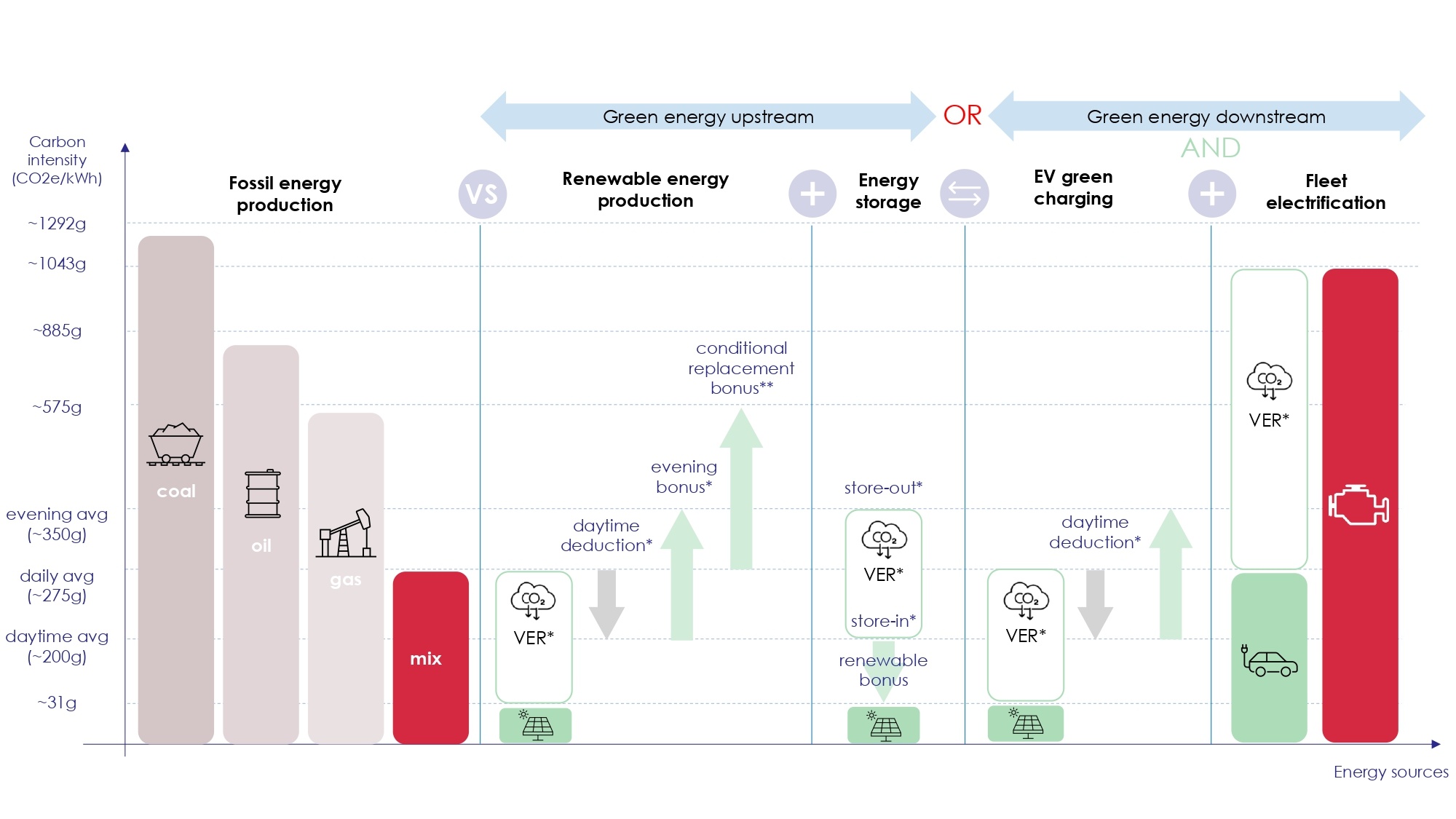
Four main obstacles hinder the spreading of electrification:
the renewable energy production challenge,
the energy storage challenge,
the charging challenge
and last, the EV challenge.
We target all of them with methodologies that built upon each-other.


.png?width=120&name=energy%20storage%20feh%C3%A9r%20ikon%20(1).png)
How can companies reduce Scope 3 emissions?
Because Scope 3 sits outside direct operations, it requires collaboration rather than internal policy alone. Mitigia helps companies connect procurement decisions with measurable supplier-side reduction outcomes.
Working with suppliers
Redesigning sourcing decisions
Reducing material intensity
Implementing insetting programs
Understand where your Scope 3 emissions can be reduced most effectively.
We help you turn supplier collaboration into measurable results.
Which emission reduction actions deliver the fastest results?
Our methodologies complement each other
...and cover the whole of the electrification ecosystem from renewable energy production to fleet electrification projects.

MONETIZE YOUR EMISSIONS REDUCTIONS
What is a carbon credit?

When you replace a CO2 intense technology with a more climate friendly or even a net zero one, you "spare" CO2 emissions. Thus, you, as an economic entity, realise a so called carbon gain. By comparing the two technologies, the volume of this carbon gain can be precisely measured, verified and reported, and exchanged into Verified Emission Reduction (VER) or Voluntary Carbon Unit (VCU).
What appears as a „spared" or "negative emission” on the green investors' side is sought after by net emitters whose emission volumes exceed the regulatory limits (and cannot avoid or reduce by themselves). These emitters either pay a penalty fee or buy carbon credits in exchange for their emissions. By choosing the second option they turn their ESG obligations into an opportunity to invest in green investments.
mitigia helps green investors originate and register carbon credits based on their electrification investments, and sell such carbon credits to large emitters.
Our know-how is compliant with the requirements of the VCM, thus the carbon credits originated through mitigia’s methodology qualify as high integrity carbon credits.
These credits represent a higher quality for the buyers, who are willing to pay a higher price for the reliability and transparency of the underlying projects the credits were originated from.
Our Partners
Proving real impact
How do you prove emission reductions are real?
We Emission reductions are proven through measurement, reporting, and vertification (MRV)
Start identifying where your emissions can be reduced most effectively.
We help you turn insights into measurable action across your operations and supply chain.
Emission reduction vs offsetting: what should companies prioritize?
Companies should prioritize reducing emissions first, then use offsetting only for unavoidable residual emissions.
Offsetting can play a role, but long-term credibility comes from lowering actual emissions inside operations and value chains. The strongest climate strategies combine reduction first, compensation second.