What is the Voluntary Carbon Market?
The Voluntary Carbon Market is a global marketplace where carbon credits are generated from projects that go beyond regulatory requirements. The VCM is an important pillar of the global climate action initiatives. Various project types are eligible for carbon credit generation starting from forestation and land use change projects, going through technology-based emission reductions trasitioning to low-carbon technologies, ending up in carbon removals. After rigorous verification, they can be traded to greenhouse gas emitters to offset their residual emissions.
When a legal entity purchases carbon credits for offsetting purposes, they are also voluntarily contributing to the fight against climate change, by financing these green projects. In this understanding, the Voluntary Carbon Market encourages the spread of low-carbon innovations by offering transparent, reliable offsetting opportunity for emitters who are embarked on their sustainability journey but facing serious technological or business constraints to deliver on promises on their own.
Exploring how carbon markets could fit your strategy?
Speak with our team to understand where to start.
How does it work?
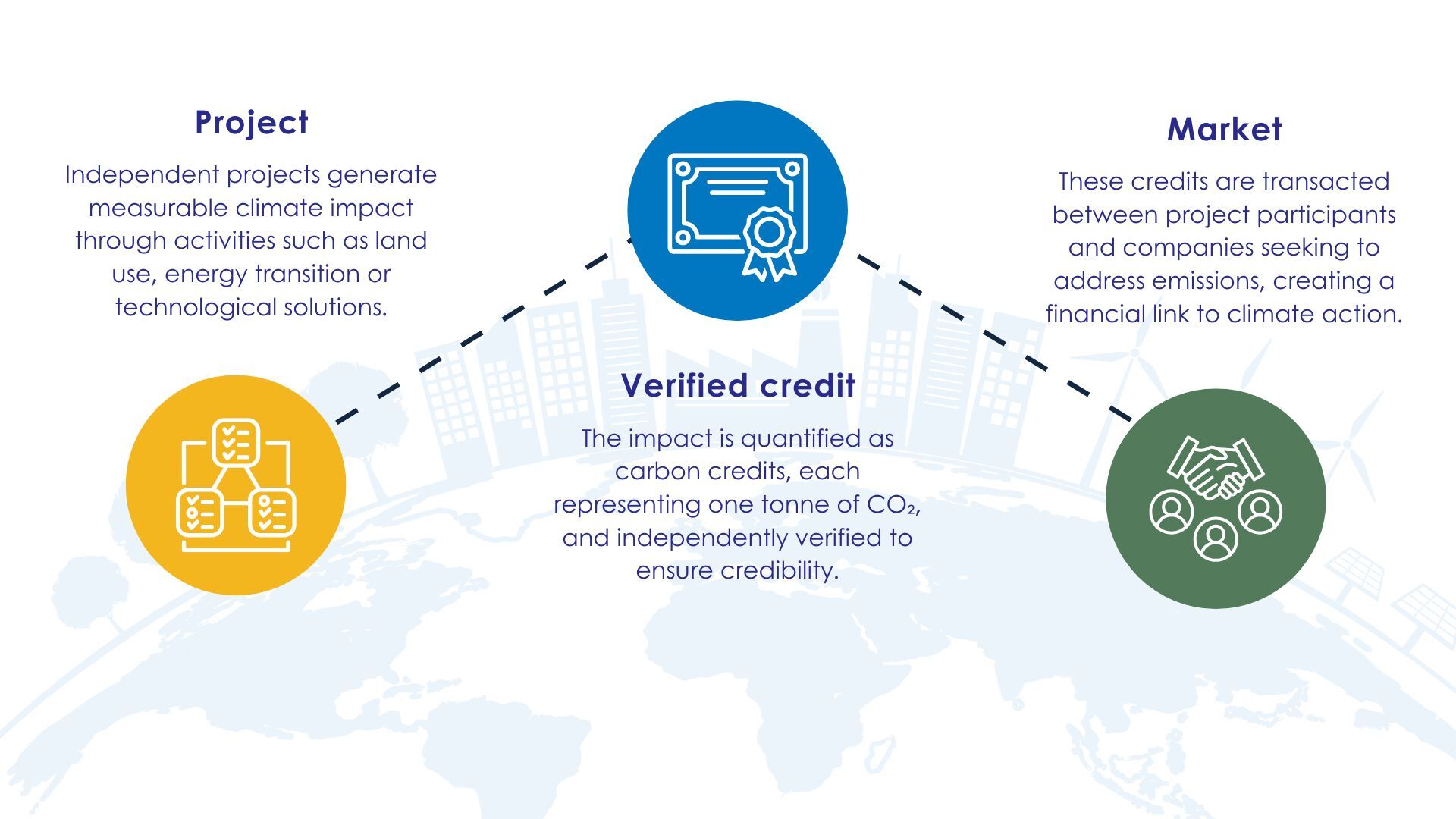
Projects in the Voluntary Carbon Market generate carbon credits by delivering measurable climate impact beyond regulatory requirements. Once project activities are verified, these credits can be purchased by companies following one of the available scientific corporate standards to address their residual carbon emissions. In doing so, companies not only compensate for their carbon footprint, but also contribute to financing projects that support the transition to a low-carbon economy.

Explore our solutions
360° service for carbon credit generation, registry, and trading with mitigia’s third-party verified Digital MRV.
They are already benefiting from carbon credits generated by their green investments

Our Clients
Looking to apply this in practice?
We help structure carbon credit strategies aligned with your business.
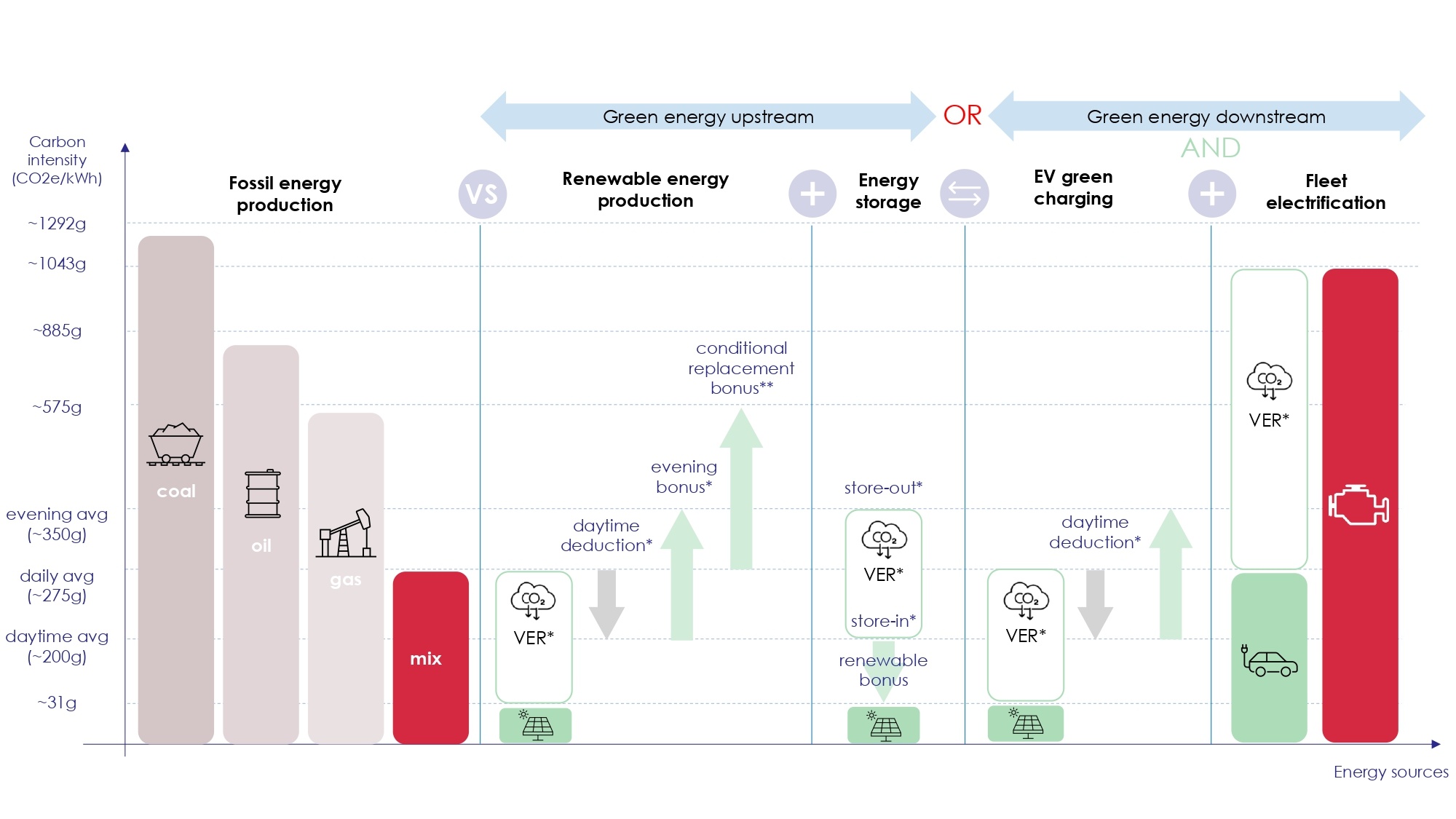
Four main obstacles hinder the spreading of electrification:
the renewable energy production challenge,
the energy storage challenge,
the charging challenge
and last, the EV challenge.
We target all of them with methodologies that built upon each-other.



.png?width=120&name=energy%20storage%20feh%C3%A9r%20ikon%20(1).png "energy storage fehér ikon (1)")
Not all carbon credits are equal
Carbon credits may look similar, but the underlying green projects behind them can differ significantly. Some projects focus on avoiding or reducing existing carbon emissions, while others remove carbon dioxide from the atmosphere and store it over longer periods of time in a long-term storage. These differences influence how the impact is generated, how long it lasts, and how reliably it can be measured.
At the same time, not every project and resulting carbon credits are equally relevant for every company intending to purchase offsets. The choice of carbon credits increasingly depends on how well a project aligns with a company’s activities, values, and strategy in climate action. As expectations around transparency and accountability grow, companies are moving beyond generic approaches and placing greater emphasis on both project quality and strategic fit.
Choosing the right projects is not trivial.
We help identify credits that align with your strategy and credibility goals.
Five megatrends
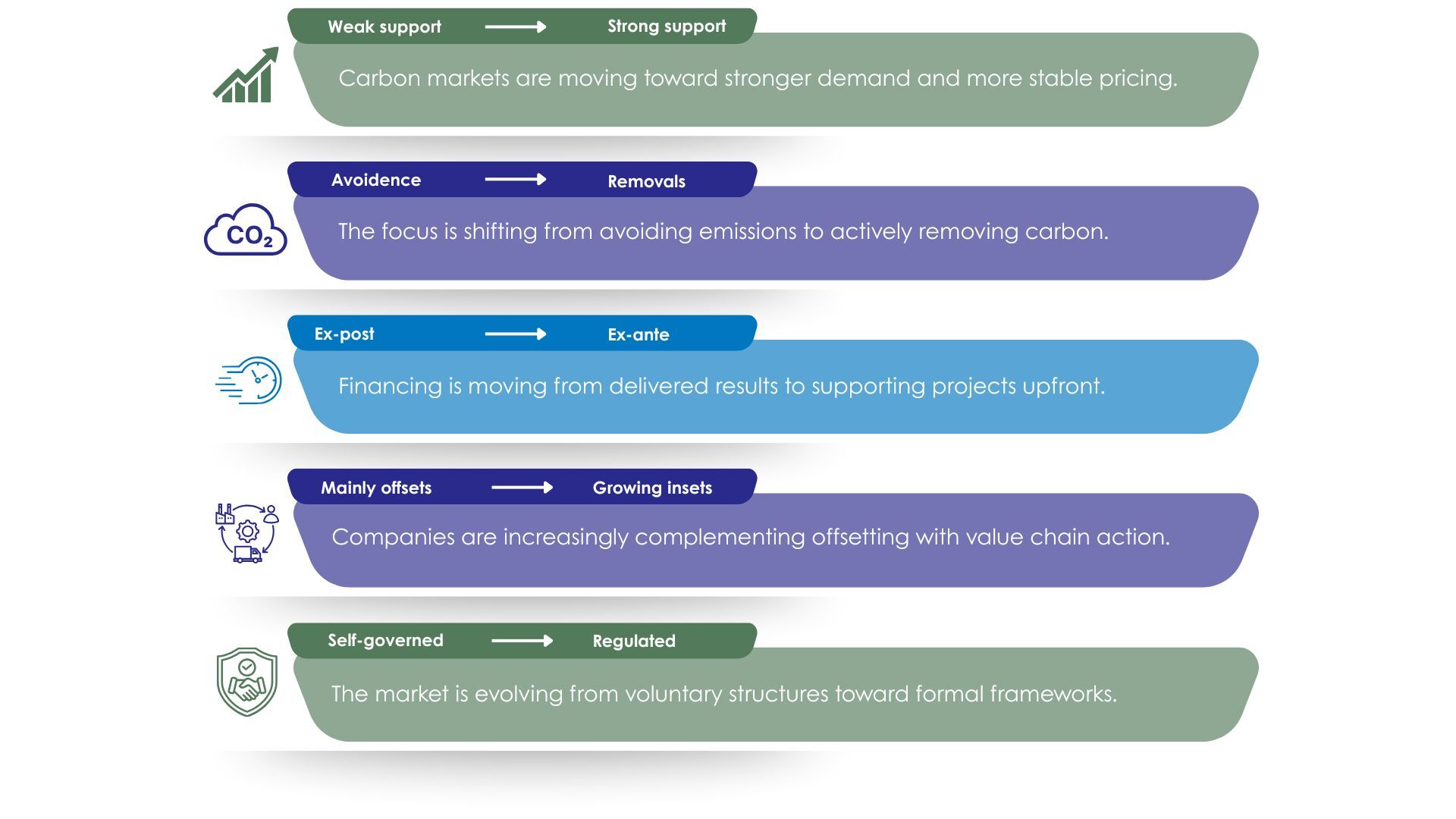
The Voluntary Carbon Market is undergoing a structural shift, shaped by several interrelated megatrends. At the level of standards and frameworks, the market is moving from fragmented, lower-quality approaches toward more robust and higher-integrity systems. At the same time, the underlying project landscape is evolving from traditional emission reduction projects toward carbon removal solutions, where the climate impact can be more directly measured and maintained over time.
Changes are also visible in how projects are financed. While earlier models were largely based on ex-post transactions, there is a growing shift toward ex-ante financing structures, such as offtake agreements, linking project development more closely to future demand. The scope of climate action is also expanding. Companies are increasingly looking beyond traditional offsetting and exploring insetting approaches within their own value chains, integrating climate action more directly into their operations.
Finally, the regulatory environment is becoming more structured. What was once a largely self-regulated market is gradually moving toward formalised frameworks, with initiatives such as the EU’s Carbon Removal and Carbon Farming (CRCF) aiming to introduce clearer rules and greater consistency. Taken together, these developments are reshaping the market, with a stronger emphasis on quality, transparency and alignment with long-term climate objectives.
Want to understand how regulation is shaping this shift?
Explore the EU CRCF frameworks and its implications.
The role of frameworks
As the Voluntary Carbon Market evolves, the need for clearer definitions and consistent approaches becomes more pronounced. A wide range of methodologies and certification frameworks already exist , each defining how carbon credits are generated, how impact is measured, and how results are verified. These frameworks form the technical backbone of the market, enabling different types of projects to operate across sectors and regions. Rather than creating a single unified system, the Voluntary Carbon Market is shaped by this diversity. What ultimately matters is not the framework itself, but how reliably they ensure that climate impact is real, measurable, and verifiable.

Ready to move from strategy to execution?
We support the full lifecycle of carbon credit development and transactions.
Applying the theory in practice
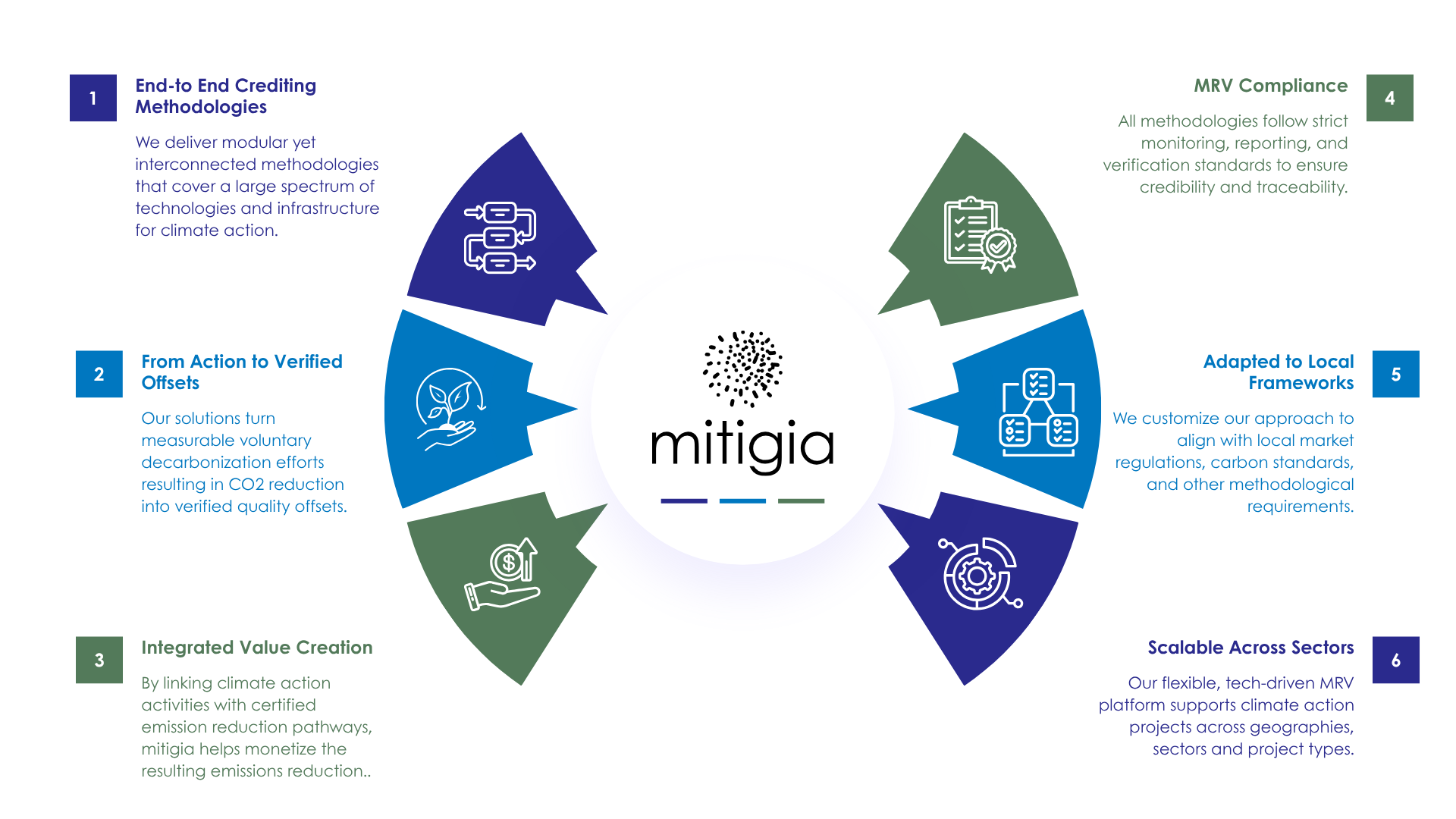
Our methodologies have been developed in a way to work across multiple sectors, including clean energy, e-mobility and waste management, creating a coherent approach to carbon credit generation. In practice, markets differ significantly across regions. Local regulations, verification standards and accepted methodologies shape how carbon credits are issued and what is considered valid.
Our approach adapts to local market structures, ensuring that emission reductions are measured correctly and aligned with regional requirements. This level of adaptability is essential for scaling climate solutions across different geographies and industries, while maintaining the integrity of the resulting carbon credits.
Our methodologies complement each other
...and cover the whole of the electrification ecosystem from renewable energy production to fleet electrification projects.
MONETIZE YOUR EMISSIONS REDUCTIONS
What is a carbon credit?
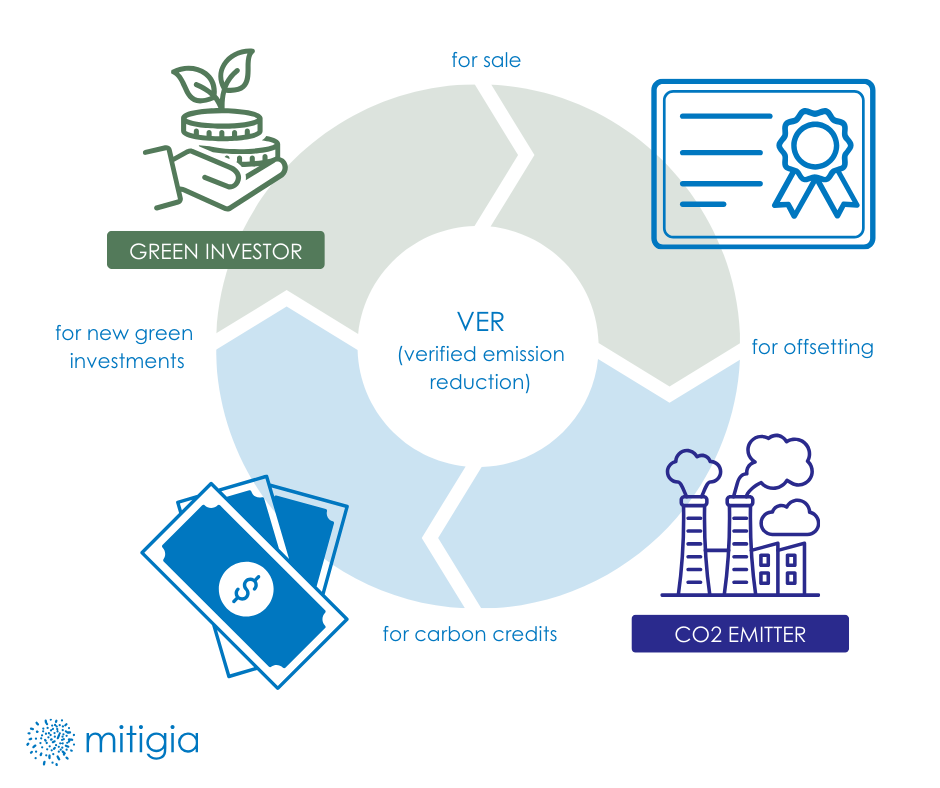
When you replace a CO2 intense technology with a more climate friendly or even a net zero one, you "spare" CO2 emissions. Thus, you, as an economic entity, realise a so called carbon gain. By comparing the two technologies, the volume of this carbon gain can be precisely measured, verified and reported, and exchanged into Verified Emission Reduction (VER) or Voluntary Carbon Unit (VCU).
What appears as a „spared" or "negative emission” on the green investors' side is sought after by net emitters whose emission volumes exceed the regulatory limits (and cannot avoid or reduce by themselves). These emitters either pay a penalty fee or buy carbon credits in exchange for their emissions. By choosing the second option they turn their ESG obligations into an opportunity to invest in green investments.
mitigia helps green investors originate and register carbon credits based on their electrification investments, and sell such carbon credits to large emitters.
Our know-how is compliant with the requirements of the VCM, thus the carbon credits originated through mitigia’s methodology qualify as high integrity carbon credits.
These credits represent a higher quality for the buyers, who are willing to pay a higher price for the reliability and transparency of the underlying projects the credits were originated from.